If Fortnite were a patient, the diagnosis would read: erratic pulse, strong appetite, slightly addicted to novelty. In other words perfectly healthy for a live-service game in 2026.
The Heartbeat Is Still Strong
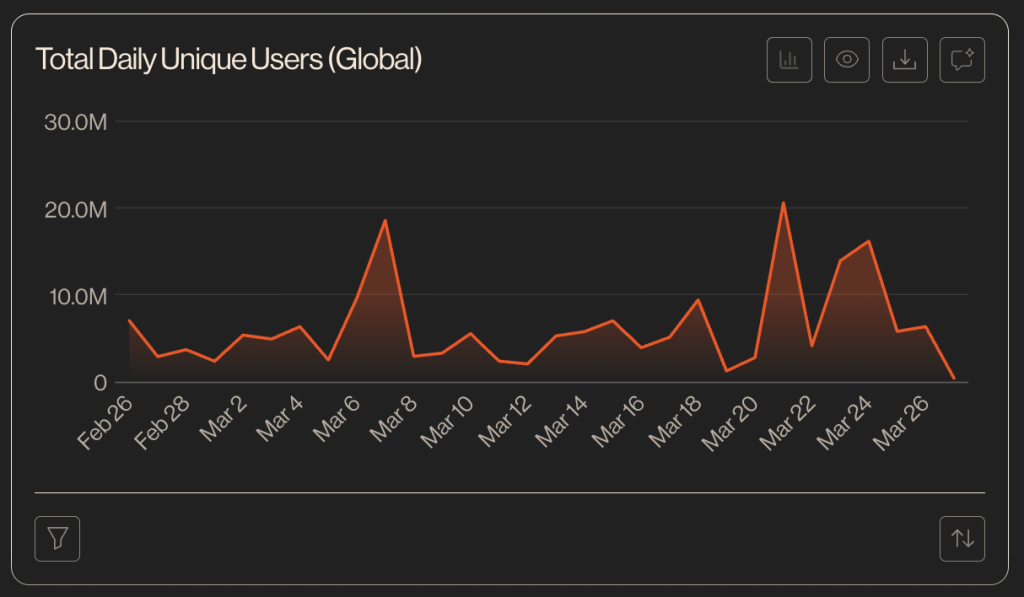
Daily unique users swing hard. From late February through March, the data shows two major spikes, one near ~19M on March 8 and another hitting ~21M around March 22 — before dropping back to a baseline of 5–8M. That’s not decline. That’s event-driven elasticity.
Fortnite no longer behaves like a steady multiplayer game. It behaves like TikTok. Peaks come from moments, not routine. The ceiling remains high; getting there just requires a trigger.
Battle Royale Still Pays the Bills
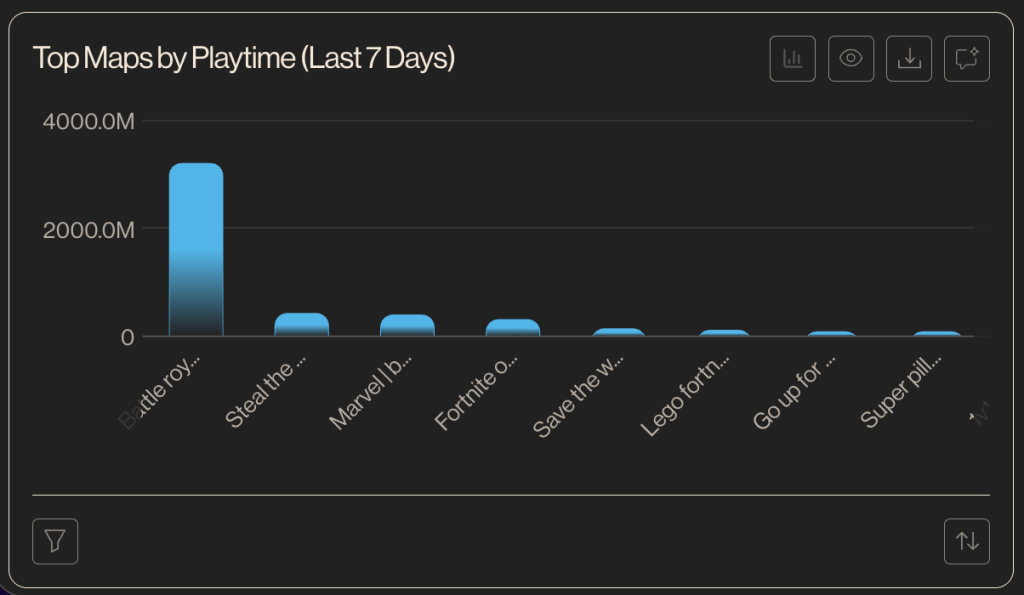
The playtime gap is starker than most people realise. Battle Royale logged roughly 3,000M minutes in the last 7 days. The next closest, “Steal the Brainrot” sits at around 300–400M. Everything else barely registers on the same chart.
Creative isn’t replacing BR; it’s orbiting it. The ecosystem is additive, not cannibalistic, at least for now.
Discovery Is Powered by Spikes, Not Stability
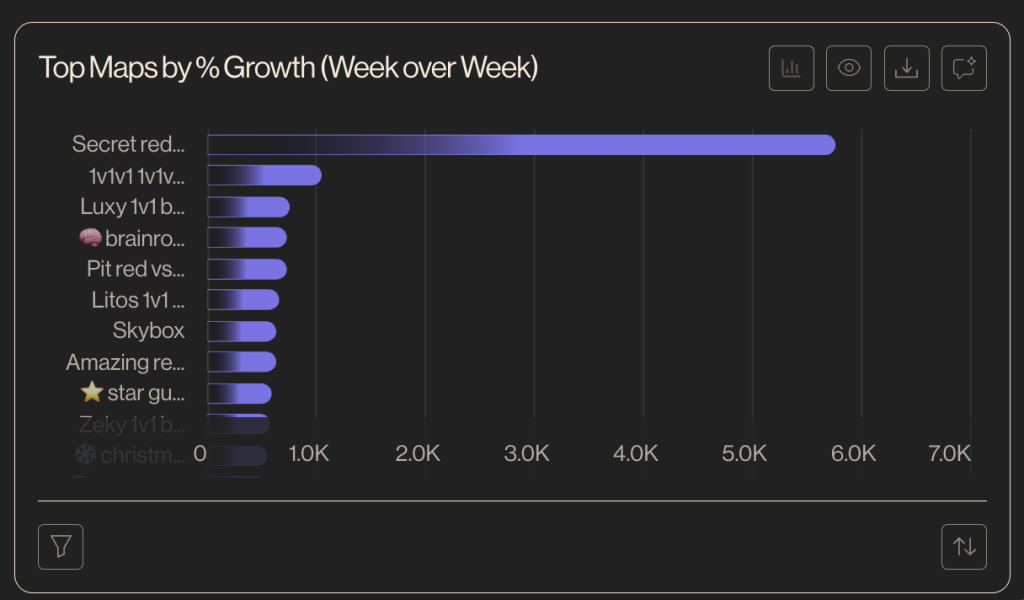
The week-over-week growth chart makes one thing immediately clear: “Secret red vs blue” grew approximately 6,000% in a single week. The runner-up, a 1v1v1 map, came in around 1,200%. After that, growth falls sharply.
These aren’t slow burners. They’re viral bursts. Fortnite Discover behaves more like YouTube Shorts than a traditional game store — if you don’t pop fast, you don’t pop at all.
Engagement Shows a Winner-Takes-Most Pattern
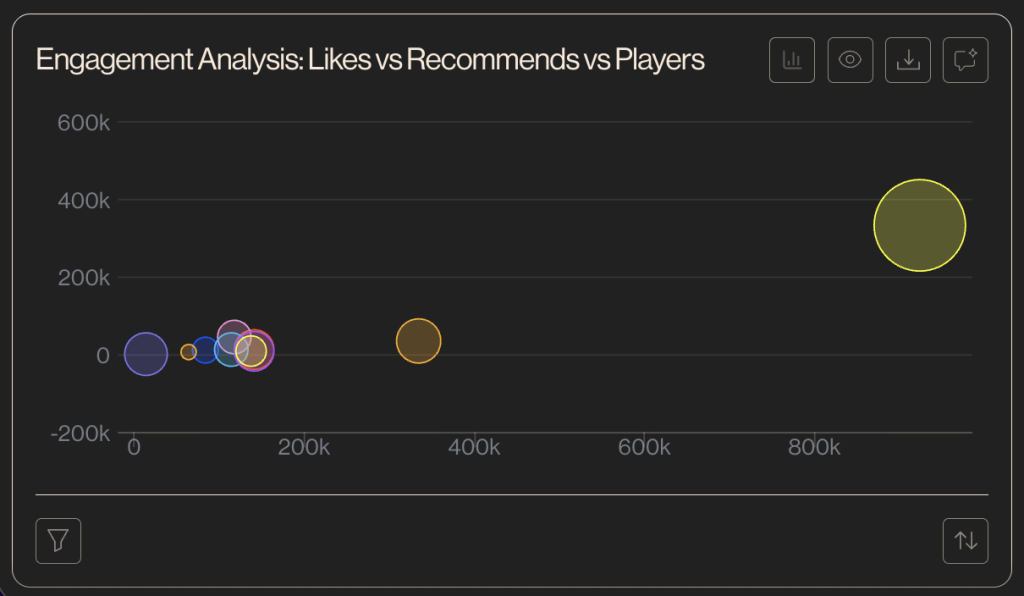
The engagement scatter plot is almost comically lopsided. One map sits alone at roughly ~900K players with ~400K likes and recommends. Every other map clusters in the bottom-left corner, barely visible at scale.
This is a textbook power-law distribution. Fortnite Discover isn’t crowded — it’s top-heavy. But that’s also what keeps the ecosystem exciting: a new map can still break through. It just has to break through hard.
Genres: Chaos, Not Monoculture
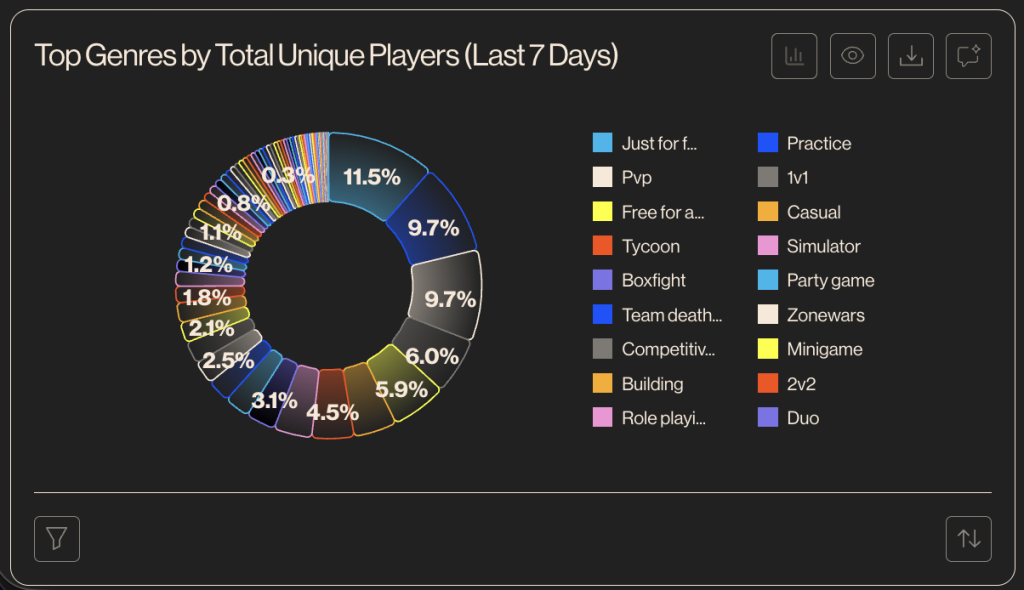
No single Creative genre dominates. “Just for Fun” leads with 11.5% of unique players, followed by PvP and Free-for-All at 9.7% each, then Tycoon (6.0%) and Boxfight (5.9%). The long tail continues through Team Deathmatch, Competitive, Building, and Roleplay — none individually significant.
The largest slice being just 11.5% is a bullish signal for a platform this size. Players aren’t locked into one format, experimentation still works, and trends can shift quickly. Fortnite is less “one meta” and more controlled chaos.
Featured Maps Reinforce the Viral Loop
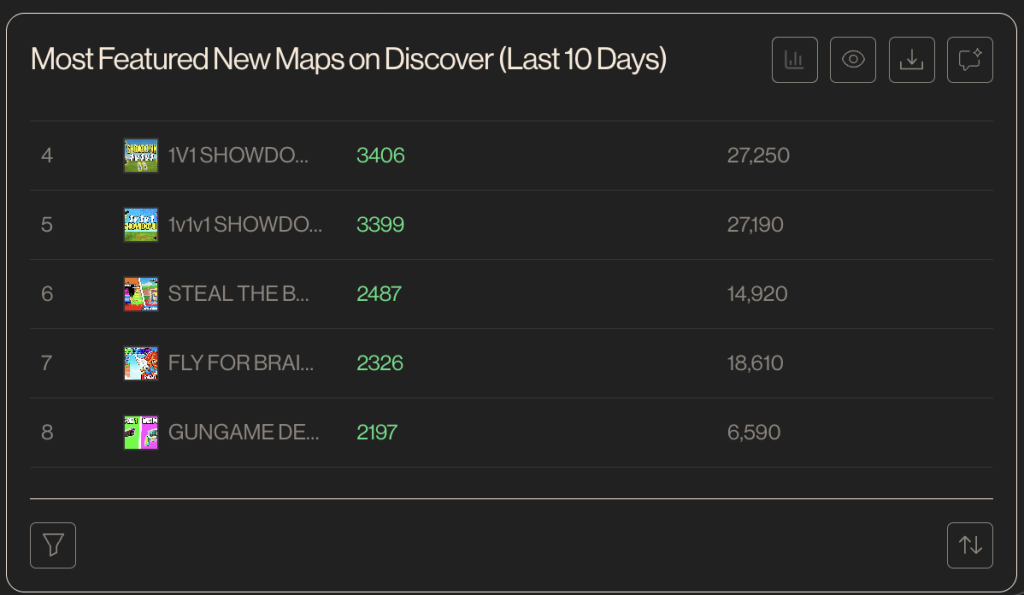
The most-featured new maps of the last 10 days tell a consistent story: 1V1 SHOWDOWN (3,406 features, 27,250 players), 1v1v1 SHOWDOWN (3,399 features, 27,190 players), STEAL THE BRAINROT (2,487 features, 14,920 players), FLY FOR BRAINROTS (2,326 features, 18,610 players).
Short, competitive, repeatable. Epic is promoting fast entry, instant skill expression, and quick return loops, i.e. the same design logic that keeps social platforms sticky.
So… Is Fortnite Healthy?
Yes, but not in the traditional sense.
Fortnite isn’t stable. It’s elastic. It spikes, rotates trends, redistributes attention, and lets new winners emerge. That’s messy, but it’s exactly what keeps a UGC platform alive. The 6,000% week-over-week surge on a single map isn’t an anomaly, it’s the product working as designed.
The biggest takeaway: Fortnite no longer behaves like a game with modes. It behaves like a content platform with gravity.
Battle Royale is the sun. Creative is the weather. Discover is the algorithm.
And right now? The forecast is volatile with a high chance of growth.
Want insights like this for your own map?
Ask the Visceral AI chatbot anything. From retention benchmarks to Discover performance.
Stop guessing and start optimizing with real Fortnite data.