Most Fortnite creators have heard some version of this warning: you have 7 days before the algorithm forgets you. Publish, spike, fade. That’s the assumed arc.
The data tells a more interesting story.
The First Week Is a Filter, Not a Finish Line
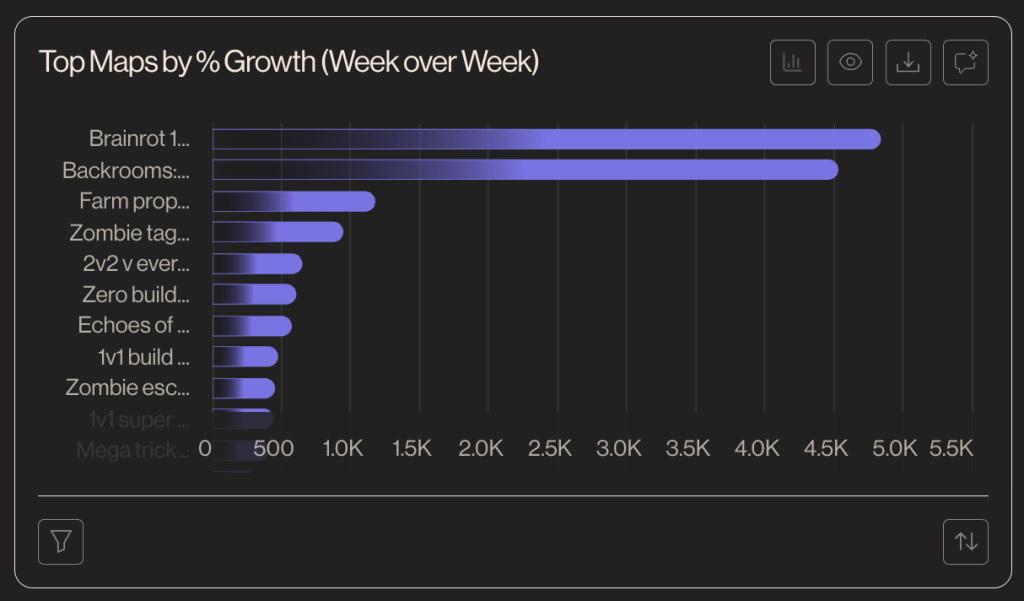
Looking at featured map performance across the last 30 days, maps in their first 7 days average just 9.36 peak CCU. That sounds brutal — and for most maps, it is. But the maps that survive that window?
They see a 440% jump in peak CCU in the following three weeks, averaging 50.55 by the 8–30 day mark.
And the maps that make it past 30 days? They average 2,691 peak CCU — nearly 300x the week-one average — with over 3,100 average feature appearances.
This isn’t a decay curve. It’s a funnel.
The Survival Bias Effect
Here’s why the numbers look the way they do: underperforming maps don’t stay in the featured rotation. They get abandoned by their creators, or deprioritised by the algorithm. What remains in the 8–30 day cohort is a self-selected group of maps that earned their place.
In other words, the 440% growth isn’t magic. It’s what happens when only the sticky maps survive.
The question isn’t “will my map last past 7 days?” The real question is: what does it take to be one of the maps that does?
What the First Week Is Actually Measuring
During launch, new maps enter a discovery spike — higher impressions, more experimental clicks, volatile retention. The algorithm is essentially testing your map on cold audiences.
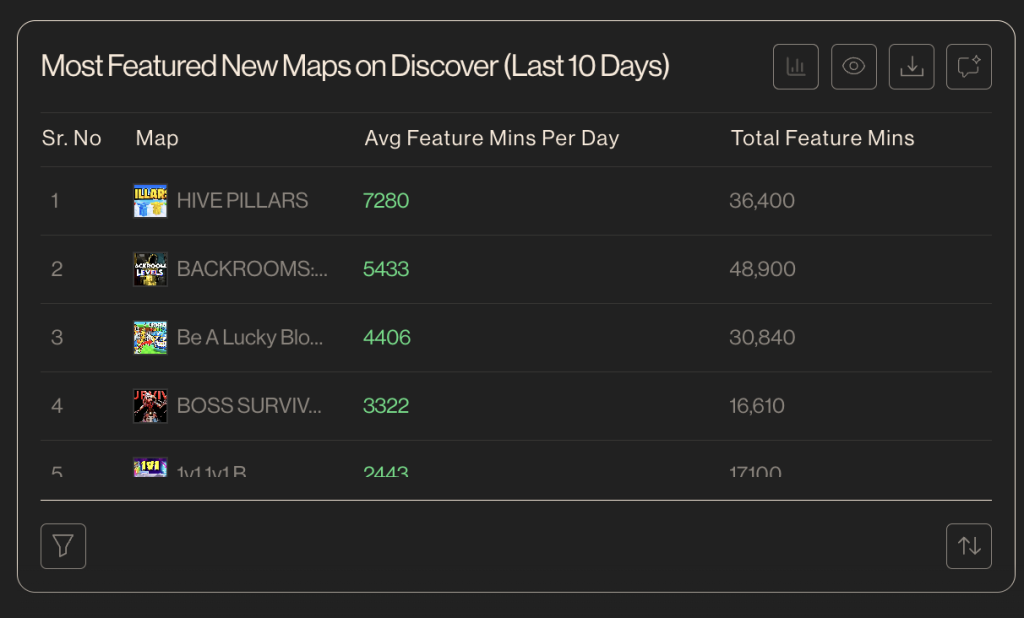
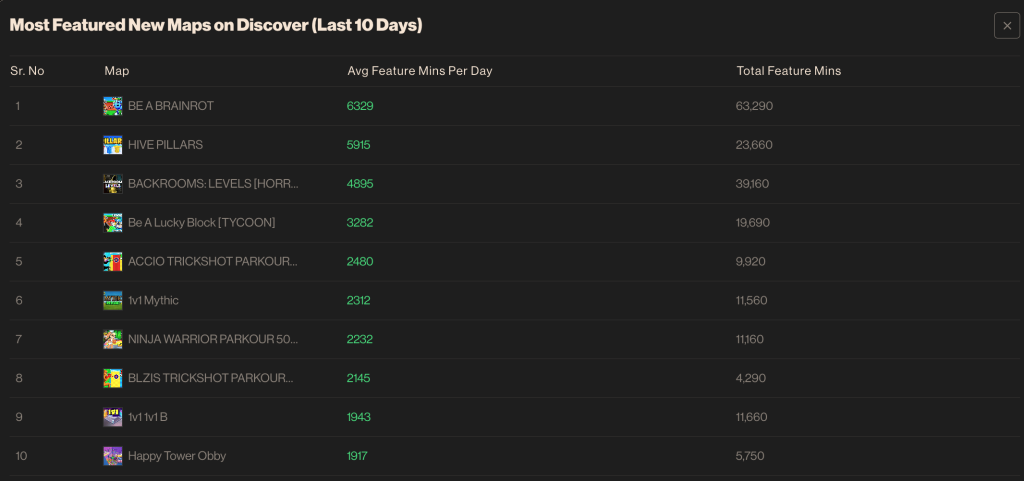
What it’s watching for isn’t raw CCU. Based on the data from Visceral’s featured map analysis, the metric that correlates most with sustained featuring is feature minutes — the total playtime your map generates while it’s in the discovery rotation.
Maps that kept players longer got featured longer. And longer featuring creates more impressions, more players, more playtime. The feedback loop is self-reinforcing.
This means the first 7 days isn’t about getting the highest spike. It’s about proving your map is worth keeping.
The Chapter Launch Window: When the Door Opens Wide
Chapter launches are a special case. During the Chapter 7, Season 2 launch weekend, 143 new maps entered the Fortnite Top 100 across three days — roughly 40–58 new entries per day.
New maps (under 7 days old) averaged 22.58 peak CCU during that period. Older maps averaged just 2.43. That’s an 89% engagement advantage for being new during a launch window.
The discovery window isn’t fixed. Chapter launches, seasonal events, and algorithm shifts can expand it significantly. Creators who understand this can time their launches to coincide with moments when the platform is actively surfacing new content.
Which Genres Survive Longest
Not all maps age the same way. Looking at which genres generate the most sustained feature appearances, two patterns emerge.
High-action genres like Simulator (~1,143 avg peak CCU) and Tycoon (~898 avg peak CCU) lead on raw player numbers. But niche categories like Choices Matter and Card Game stay featured 2–3x longer, averaging over 1,746 feature appearances. These genres have lower player volume but dramatically higher loyalty — players return, fatigue is low, and the algorithm keeps rewarding them.
The takeaway: peak CCU and feature longevity aren’t the same thing. A smaller, deeply loyal audience can outlast a bigger, more casual one.
What This Means for Creators
If the first 7 days is a filter, your job during that window is to pass it. That means:
Optimise for retention, not launch noise. A Day-1 spike that doesn’t convert to Day-2 play hurts your standing with the algorithm. Early retention signals are what extend your featuring window.
Build for short loops, not long setups. The maps that pass the filter share a pattern: fast onboarding, repeatable gameplay, and sessions that players choose to extend — not ones they endure.
Time your launch deliberately. Chapter launches, season starts, and event windows dramatically increase the volume of new maps getting surfaced. A strong map launched at the right moment gets substantially more discovery exposure than the same map launched on a quiet Tuesday.
Don’t read week one as the final verdict. Maps at 9.36 average CCU in week one don’t look like hits. The ones that earned their way to 50+ by week four didn’t look like hits either — until they were.
The Takeaway
The 7-day window is real. But it’s not a deadline. It’s a test.
The Fortnite algorithm is asking a simple question in those first seven days: do players come back? Maps that answer yes don’t fade. They compound.
Your map’s first week isn’t about going viral. It’s about proving it’s worth keeping around.
Want insights like this for your own map?
Ask the Visceral AI chatbot anything. From retention benchmarks to Discover performance.
Stop guessing and start optimizing with real Fortnite data.