Tag: Fortnite ccu

  • ‘Funny’ Is One of the Most Powerful Genres in Fortnite

    ‘Funny’ Is One of the Most Powerful Genres in Fortnite

    Fortnite Creative isn’t just trending toward bigger progression systems or deeper tycoons. The data is pointing somewhere else: humor-driven maps are quietly becoming one of the strongest retention engines in the ecosystem.

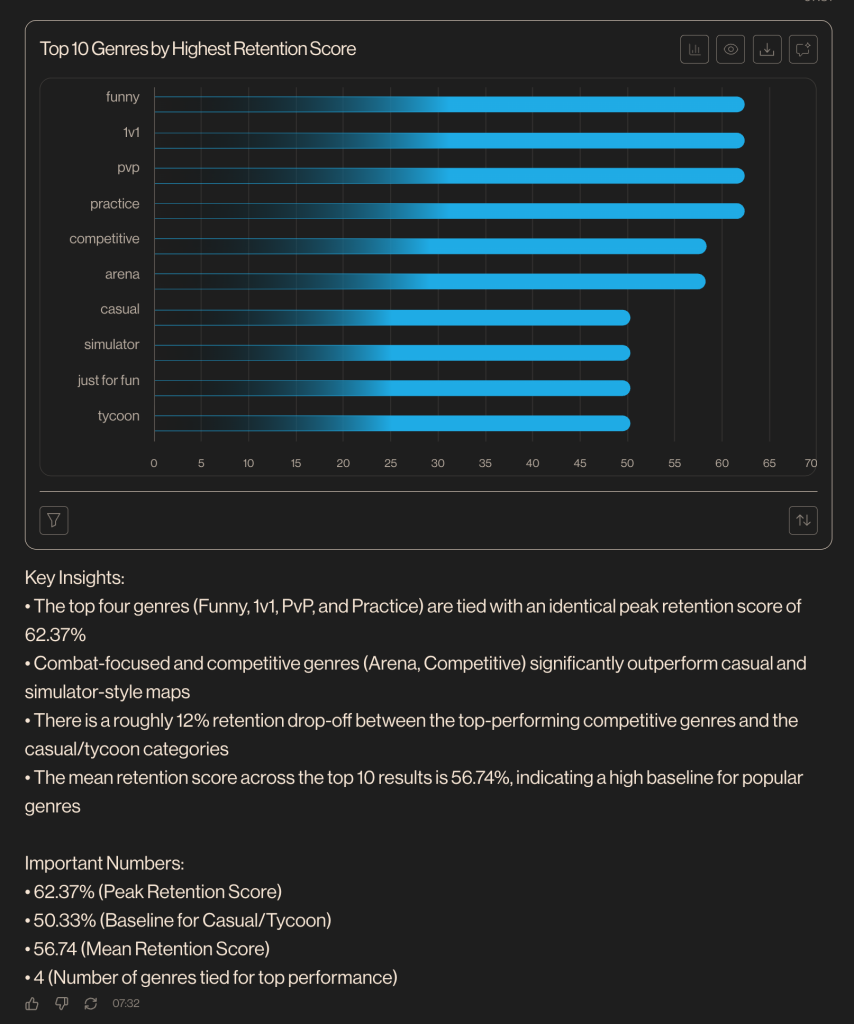
    According to Visceral data, the “Funny” genre sits at the very top of retention, tied with 1v1, PvP, and practice maps at roughly 62% retention. That puts it well above simulator, casual, and tycoon experiences, which cluster closer to the ~50% range.That’s a meaningful gap. And it suggests something important: players don’t just come for chaos — they stay for it.

    Why Funny Maps Retain So Well

    1. Instant understanding
    Funny maps usually require no onboarding. The loop is obvious within seconds — press a button, trigger something absurd, repeat. No learning curve means fewer early drop-offs, which boosts retention.

    2. Fast payoff loops
    Humor relies on timing. The best funny maps deliver reactions quickly: unexpected physics, exaggerated outcomes, or rapid resets. Short loops encourage repeat behavior and keep players engaged.

    3. Social stickiness
    Funny gameplay is inherently shareable. Players stick around to see what happens to others, react together, or retry moments. This creates lightweight social engagement without needing complex systems.

    The Shift Toward “Brainrot” Gameplay

    This trend aligns with a broader movement in Fortnite Creative: low-friction, high-reaction experiences. Instead of long progression arcs, these maps focus on immediate engagement — something closer to short-form content dynamics.

    The result is simple: less depth, more replayability. And that trade-off appears to work.

    What This Means for Creators

    Humor isn’t just a theme, it’s a design strategy.
    If retention is your goal:

    • Reduce onboarding friction
    • Shorten your gameplay loop
    • Add unexpected or reactive moments
    • Prioritize instant payoff over long buildup

    Funny maps don’t need massive systems to succeed. They rely on clarity, speed, and repeatable reactions and the data suggests that’s enough to keep players coming back.In Fortnite Creative, progression may drive discovery.


    But increasingly, players stay for the laughs.

    Want insights like this for your own map?

    Ask the Visceral AI chatbot anything. From retention benchmarks to Discover performance.
    Stop guessing and start optimizing with real Fortnite data.

  • Things you wanted to know about the Fortnite Sponsored Row but didnt know who to ask

    Things you wanted to know about the Fortnite Sponsored Row but didnt know who to ask

    Hey UEFN Creators! We’ve all stared at that “Sponsored” row in the Discover tab and wondered, Does paying for placement actually work? Will it give my map the boost I want? 

    We asked Visceral’s AI analytics bot to dig into a week’s worth of hard data to demystify how the Sponsored Row actually performs. Let’s break down the real numbers behind the hype.

    The Real CCU Bump (Expectations vs. Reality)

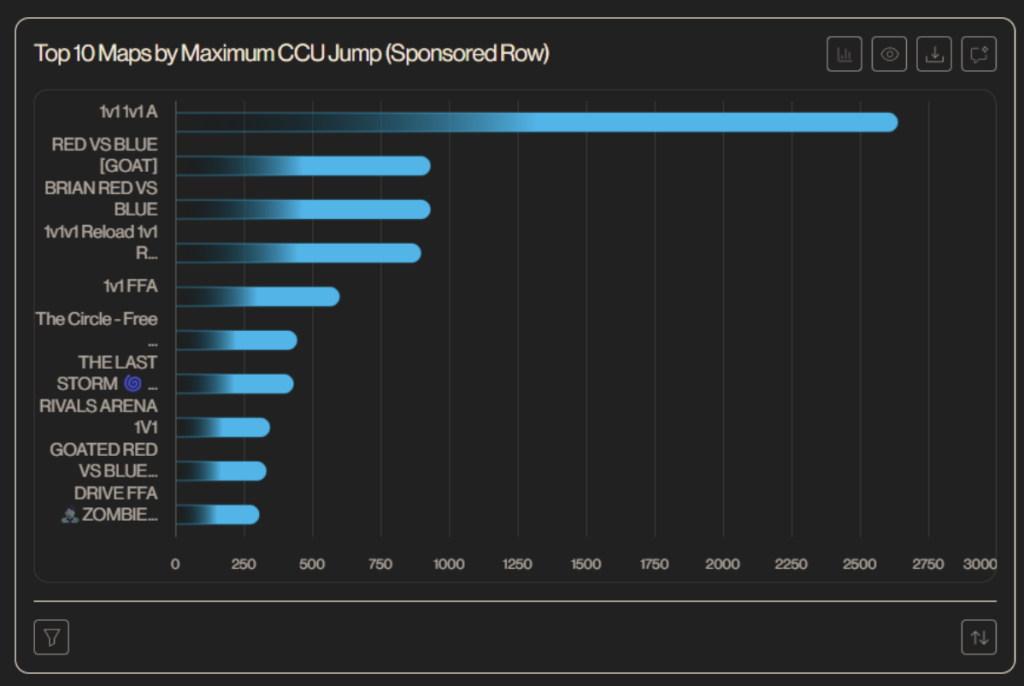
    First, a quick reality check: paying for placement isn’t a magic bullet. Over 97% of sponsored maps stay below the 500 concurrent user (CCU) threshold.  Only a slim 2.41% achieve top-tier numbers.

    However, when a map connects with the audience, the payoff is massive. 

    Competitive genres completely dominate here. Formats like “1v1” and “Red vs Blue” make up 60% of the top performers, proving these genres benefit the most from paid placement. One map, ‘1v1 1v1 A’, saw a dominant jump of 2,640 CCU! But don’t worry if you build niche modes; maps like Scrims or Zombies still saw a healthy, reliable baseline boost of 300 to 400 players, providing a great floor for discovery.

    The Organic “Halo Effect”

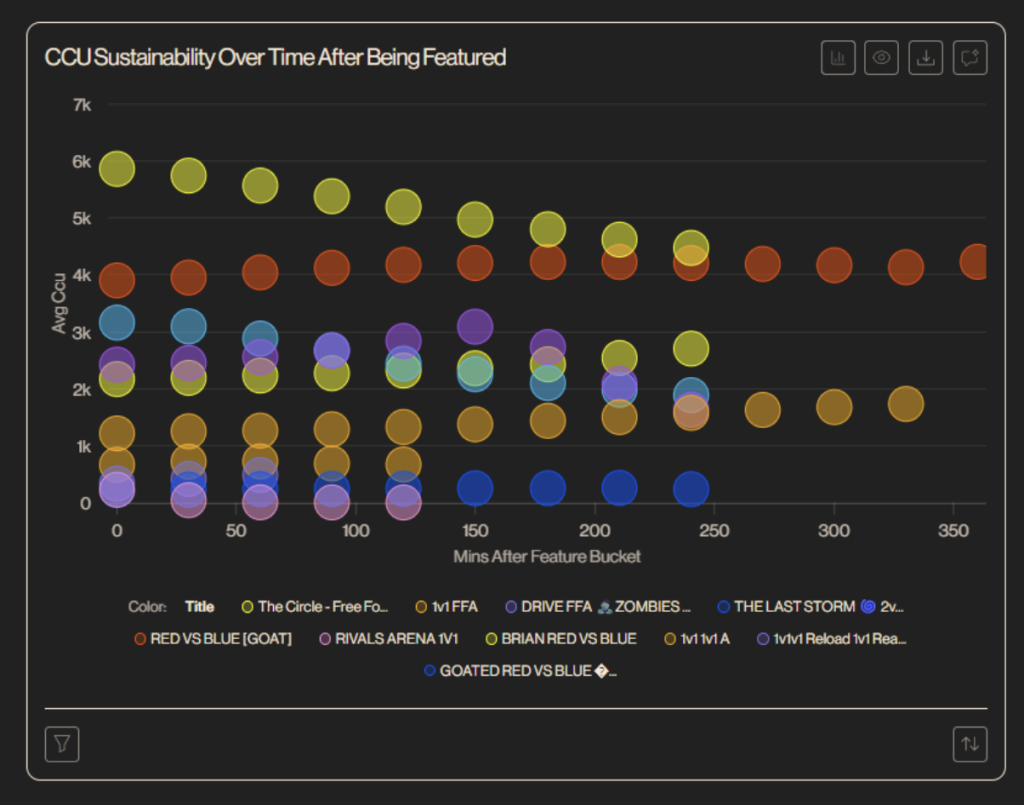
    The best part about the Sponsored Row isn’t just the paid traffic—it’s the organic snowball effect. Most maps with top ccu jumps sustain high engagement for a solid six hours (360 minutes) after being featured.

    User Query: How long did these maps sustain high ccu after being featured?

    If players stick around, the algorithm notices.

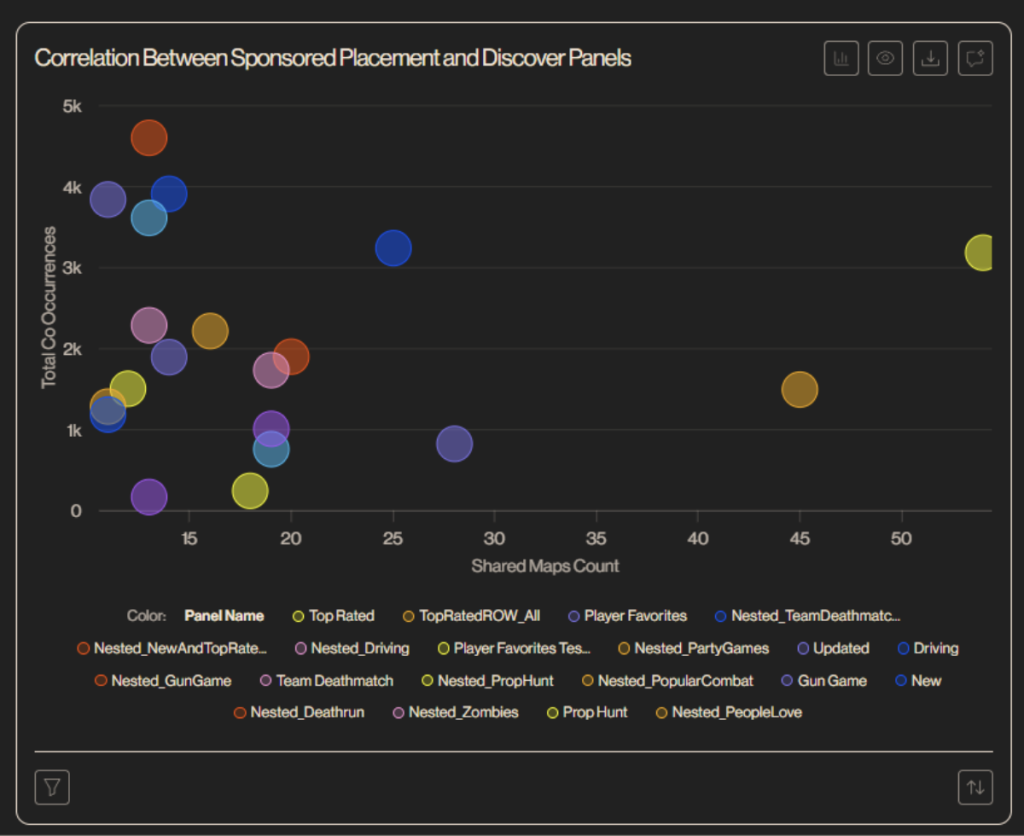
    User Query: Is there an algorithmic correlation between sponsored placement and other discover panels observable from the last week’s data?

    The data shows a strong correlation between sponsored placement and landing in panels like “Top Rated,” and “Player Favorites”. Genre specific panels such as “Team Deathmatch” and “Prop Hunt” also had high overlaps with the Sponsored row. 

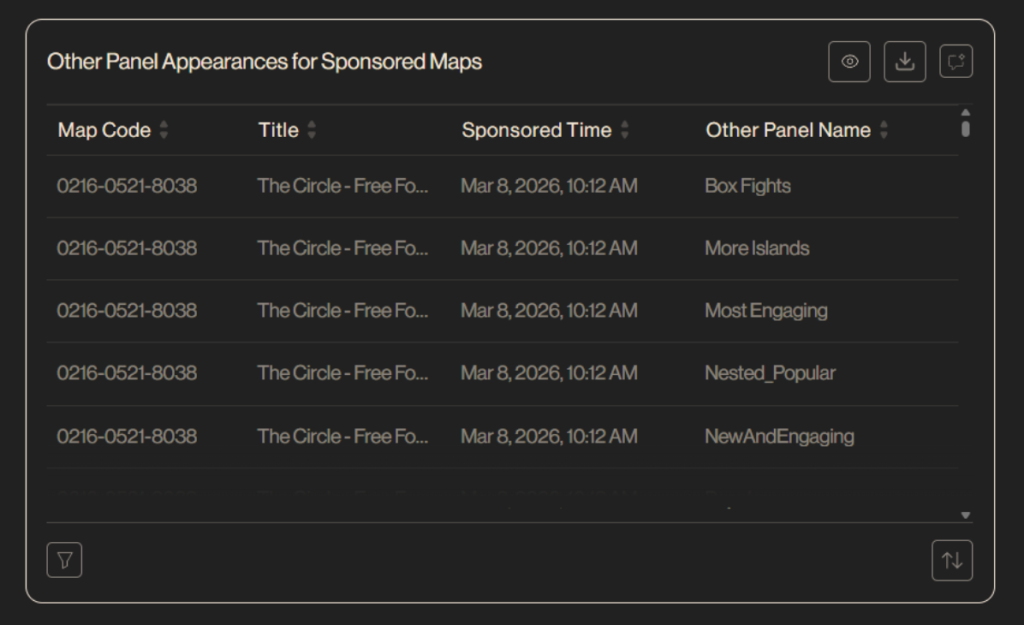
    User Query: Were these maps featured in any other discover or collections panels around the time they were featured in the sponsored panel?

    The map ‘The Circle – Free For All’ successfully maintained its presence across 7+ unique discovery rows on March 8 2026. In short: successful paid reach frequently converts into long-term organic reach.

    Timing is Everything

    If you are going to launch a campaign, timing is critical. 

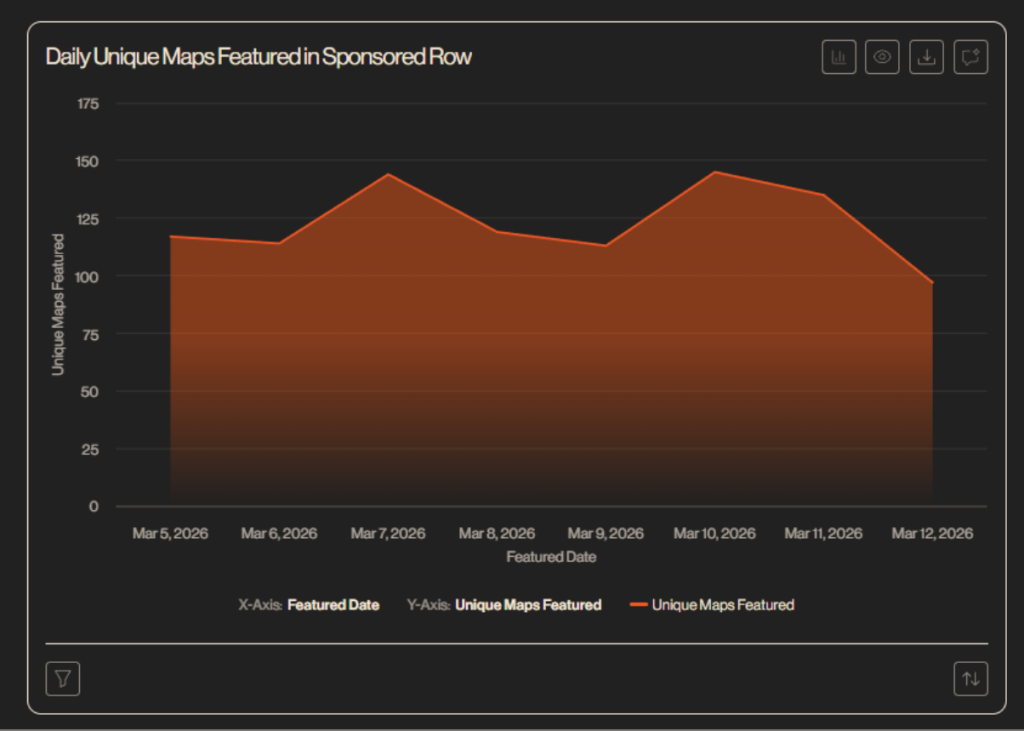
    User Query: How many unique maps were featured in the sponsored row on each day last week?

    We see high rotation during mid-week and weekends, peaking at around 144-145 unique maps per day.

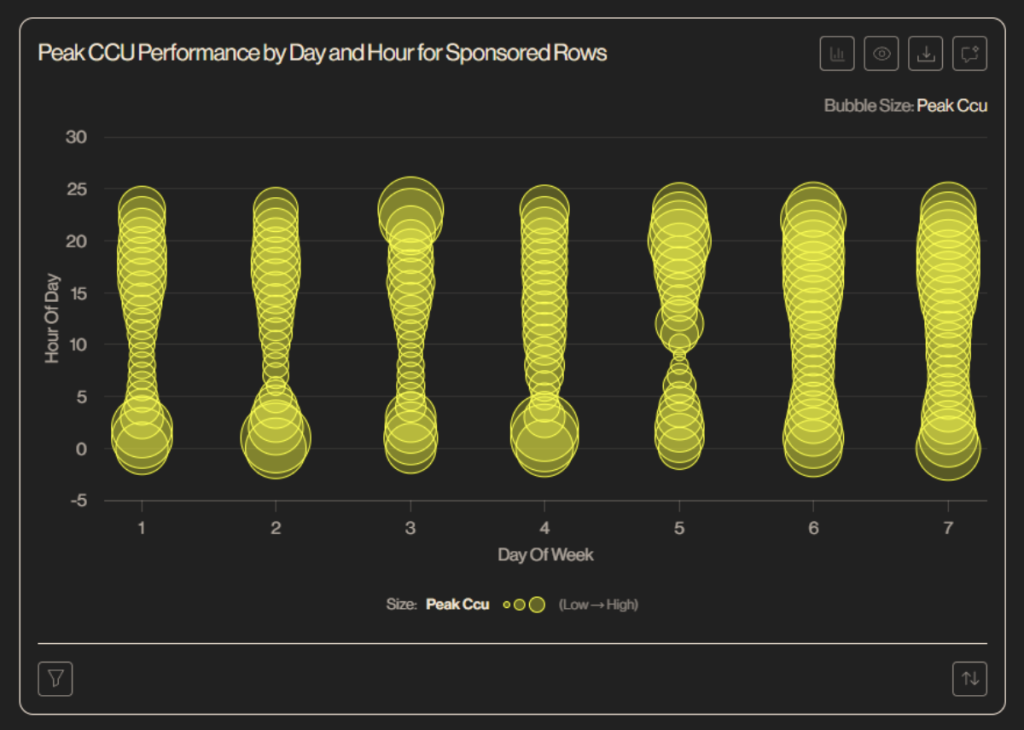
    User Query: What is the best day and time of the week to get featured in the sponsored row to achieve high ccu?

    If you’re chasing the absolute highest peak numbers, early week nights can be wild (Day 2, Tuesday, at 1:00 AM UTC hit an absolute peak of 16,542 CCU). But if you want sustained engagement—which is much better for the algorithm—Sunday is your golden ticket. Sunday holds the top three spots for highest average CCU between 5:00 PM UTC and 7:00 PM UTC. Friday nights at 10:00 PM UTC are also fantastic, reliably bringing in strong averages and peaks over 14,000.

    The Takeaway

    The Sponsored Row is an incredible amplifier, but it won’t fix a map that lacks retention. Build a highly engaging experience, target those weekend evening slots, and watch that paid visibility convert into lasting organic success!

    Want insights like this for your own map?

    Ask the Visceral AI chatbot anything. From retention benchmarks to Discover performance.
    Stop guessing and start optimizing with real Fortnite data.
  • Anatomy of a 50K CCU Fortnite Creative Map

    Anatomy of a 50K CCU Fortnite Creative Map

    Breaking 50,000 concurrent players in Fortnite Creative is rare. In our latest dataset, only three creator-made islands managed it.

    And they all have something in common.

    Brainrot.

    Every creator map crossing the 50K CCU threshold shares the same meme-native branding – suggesting that absurd internet culture may be doing some heavy lifting in Fortnite discovery.

    The Giant Outlier

    One island completely dominates the leaderboard.

    STEAL THE BRAINROT hit a peak of 1,083,892 concurrent players, accounting for over 85% of the combined peak CCU among the top three islands.

    That’s not a small lead. That’s a planet-sized lead.

    Fortnite Creative, like most creator economies, follows a familiar pattern:
    a few massive hits capture the majority of players.

    Retention Wins Games

    What’s even more interesting is that the biggest map is also the stickiest.

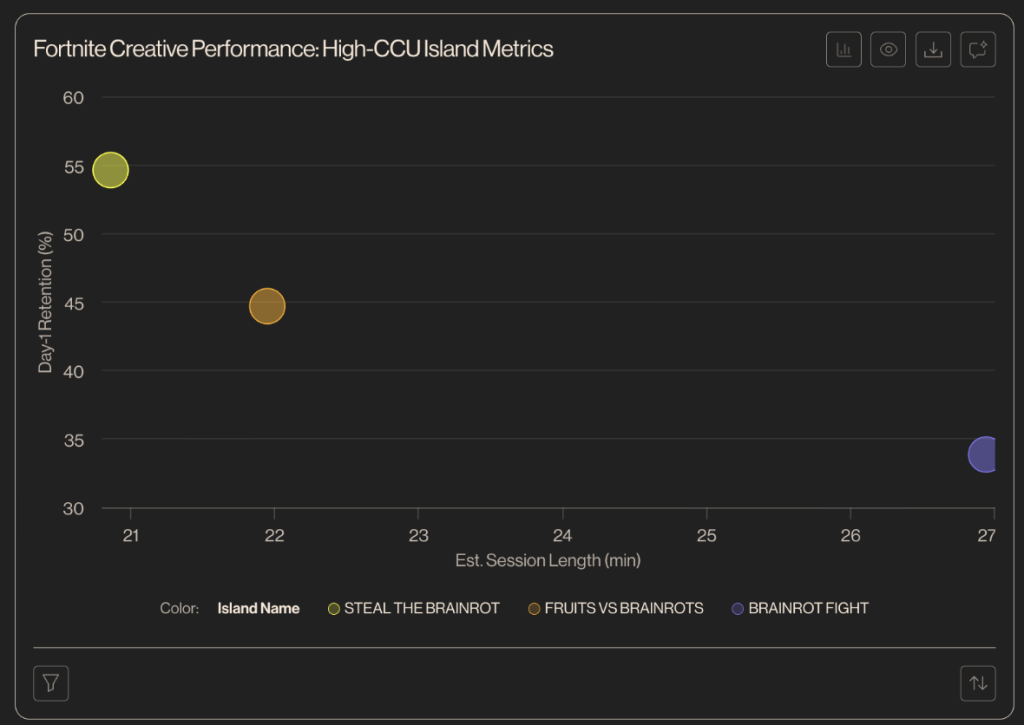
    STEAL THE BRAINROT holds a massive 54.63% Day-1 retention, meaning more than half of players come back the next day.

    Across the top islands:

    • Average session length: ~23 minutes
    • Peak retention: 54.63%

    In short: players aren’t just clicking – they’re staying.

    Different Ways to Win

    Not every map wins the same way.

    While STEAL THE BRAINROT dominates on scale, BRAINROT FIGHT actually has the longest sessions, averaging nearly 27 minutes per player.

    That suggests two different success models in Creative:

    Viral maps

    • massive player spikes
    • social spread
    • big Discover momentum

    Engagement maps

    • smaller audiences
    • longer sessions
    • deeper gameplay loops

    Both can work. They just optimize for different player behaviors.

    The Takeaway

    If there’s a lesson here, it’s this:

    • Memes get players in the door.
    • Retention keeps them there.

    Fortnite Creative might look chaotic from the outside, but underneath the memes and madness, the data tells a clear story:

    The maps that win are the ones players come back to.

    Want insights like this for your own map?

    Ask the Visceral AI chatbot anything. From retention benchmarks to Discover performance.
    Stop guessing and start optimizing with real Fortnite data.