
Fortnite Creative has evolved into a massive creator economy, but the distribution of success inside the ecosystem is far from equal.
Using Visceral.io ecosystem data across top-performing creator-made islands, a clear pattern emerges: a handful of breakout experiences capture the majority of player attention, while the rest of the market competes in a long tail of smaller audiences.

A Hit-Driven Economy
The most striking signal in the data is how concentrated player traffic is. One island – STEAL THE BRAINROT – reached a peak of 1,083,892 concurrent players, capturing significantly more traffic than the rest of the top Creative islands combined.
This reflects a classic power-law distribution seen across creator platforms like YouTube, Roblox, and Steam. A small number of hits dominate attention, while thousands of smaller experiences compete for discovery. For creators, this means the difference between a good map and a breakout hit is enormous.
Retention Drives Success
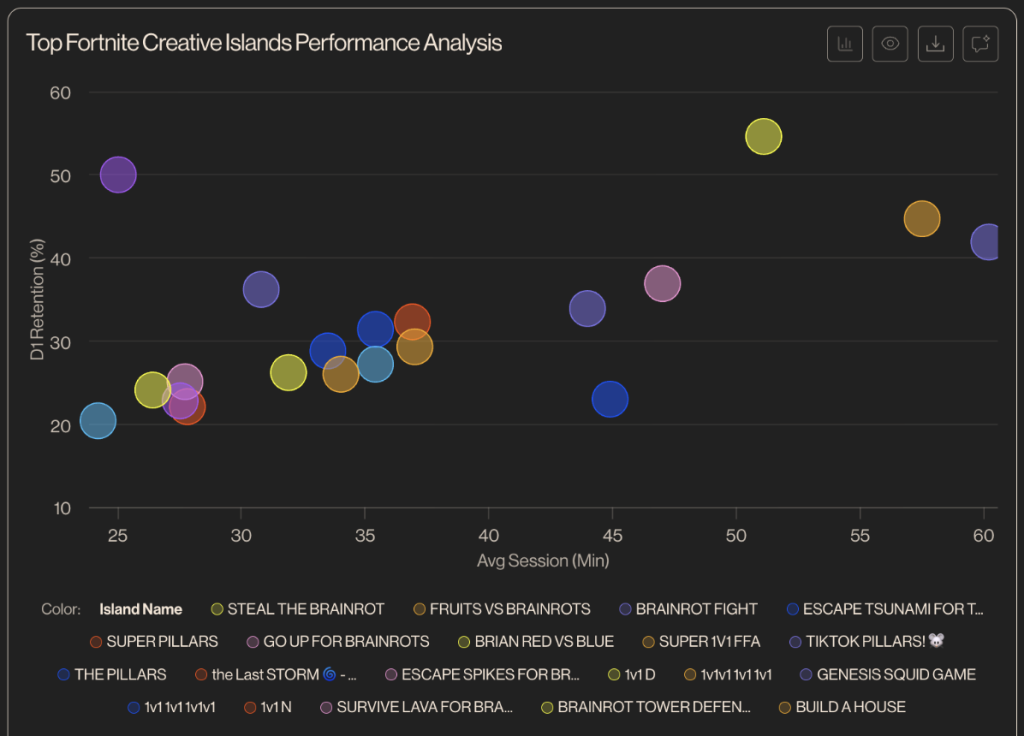
If peak CCU shows acquisition power, retention reveals the real engine behind successful islands. Two of the strongest performers in the dataset – STEAL THE BRAINROT and SUPER 1V1 FFA – both achieve over 50% Day-1 retention, meaning more than half of players return the following day.
Across the top Creative islands:
Average session length: 36.9 minutes
Mean peak CCU: 78,980 players
These numbers highlight an important pattern: maps that keep players engaged for longer sessions tend to generate stronger repeat play and sustained traffic.
The Rise of Simulator and Tycoon Formats
When we look at genres driving the strongest engagement metrics, Simulator and Tycoon maps stand out clearly.
These progression-driven experiences are producing:
- Peak CCU in the tens or hundreds of thousands
- Average session lengths exceeding 45 minutes
Unlike traditional PvP formats, these maps rely on progression loops, upgrades, and resource accumulation, creating longer play sessions and stronger player investment.
This structure mirrors the mechanics that have long powered Roblox’s most successful games.
Competitive Maps Follow a Different Pattern
Not every successful island relies on long progression loops. Low barrier competitive formats, especially 1v1 and free-for-all maps, behave differently.
Maps like SUPER 1V1 FFA generate:
- Shorter sessions
- High replay frequency
- Extremely strong Day-1 retention
Rather than holding players for long sessions, these maps succeed by encouraging quick repeat matches and habitual play.
In other words, Creative is now supporting two different engagement models:
- Progression Worlds – Long sessions, Tycoon / simulator loops, Deep player investment
- Competitive Arenas – Short sessions, Fast match cycles, High replay frequency
Both formats can succeed but they rely on very different player behaviours.
What This Means for Creators
The data suggests three clear signals for builders in the Fortnite ecosystem:
- Hits dominate the market
The majority of player traffic concentrates around a small number of breakout islands. - Retention matters more than novelty
Experiences that bring players back the next day consistently outperform those that rely purely on initial discovery spikes. - Progression systems are driving engagement
Simulator and tycoon mechanics are currently the strongest structure for sustaining long play sessions.
Fortnite Creative is no longer just a collection of minigames. It’s evolving into a full creator economy where retention systems, progression loops, and player psychology increasingly determine which experiences break out.
And as the ecosystem continues to grow, understanding the data behind those patterns will only become more important for creators hoping to build the next breakout island.
Want insights like this for your own map?
Ask the Visceral AI chatbot anything. From retention benchmarks to Discover performance.
Stop guessing and start optimizing with real Fortnite data.